
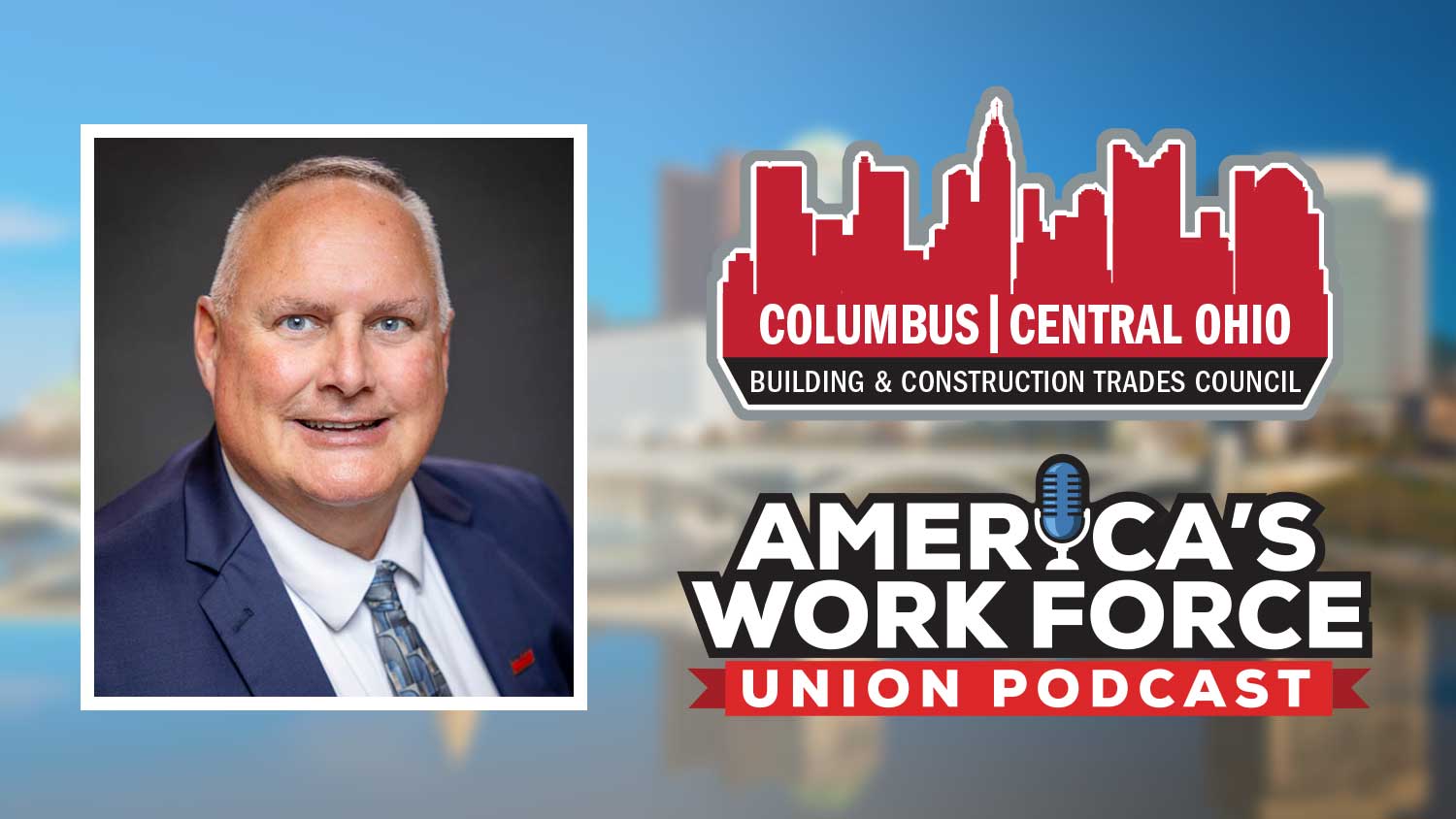
Dorsey Hager, Executive Secretary-Treasurer of the Columbus/Central Ohio Building and Construction Trades Council, joined host Ed “Flash” Ferenc on March 6 for his monthly appearance on the America’s Work Force Union Podcast. The two discussed Central Ohio’s construction momentum, how area building trades unions are ready to staff up and why the region must keep pushing back against forces that slow down critical development.
Intel update: nearly 1,000 on-site with ramp-up to 1,600 underway
Hager opened with the latest developments on the Intel chip manufacturing project in Licking County. He reported that close to 1,000 building trades members are currently working on-site, and Bechtel plans to bring on roughly 600 more workers in the next 60 to 90 days as weather improves and exterior work increases.
Hager noted the project continues to track toward Intel’s goal of producing chips by 2031 and emphasized the broader ecosystem it is helping to build, including data centers, behind-the-meter power projects and anticipated supplier arrivals in the next year to year and a half.
Data center pushback: NIMBYism, Asheville and the power question
Ferenc then asked about the growing resistance to data centers in communities across Ohio. Hager said the opposition mirrors what the trades saw with the expansion of solar projects —“NIMBYism,” misinformation, and a small number of vocal opponents putting pressure on elected officials.
He detailed a recent situation in Asheville, Ohio, in which PowerConnects and EdgeConnects reached an agreement with the village to annex land for a larger data center campus. The deal included $35 million for local schools and a full redo of the village’s troubled water and sewage system—a project that would otherwise add roughly $174 per month to residents’ bills. Despite those benefits, the mayor resigned amid death threats and community backlash, and a newly reorganized council voted against the annexation.
The original, smaller campus of three data centers is still moving forward, Hager said, adding that the building trades are working to get into communities and address myths—including misconceptions about water use, permanent jobs and grid impact. He also cited the long-term nature of data center work, with some trades members working on the Meta campus in New Albany continuously for nearly 12 years.
Regarding behind-the-meter power, Hager said the first natural gas energy plant broke ground recently, and a second pre-job is scheduled in the coming weeks. Once those plants come online, he said, Central Ohio building trades members will not only be building and maintaining data centers but also gas and potentially hydrogen plants—creating sustained demand for skilled union workers for the next 10 to 15 years.
Bluegrass Power Station approved: up to 2,000 workers expected
Hager also shared news from the Ohio Power Siting Board, which recently approved several major projects, including the Bluegrass Power Station in Fayette County—a large-scale natural gas plant located across from two Amazon campuses on Bluegrass Parkway. He estimated the project cost at $600 million to $850 million and said a summer groundbreaking is expected.
At peak, Hager projected close to 2,000 workers on the project, including 750 to 800 electricians, 400 to 500 pipefitters and several hundred additional mechanical and civil trades workers. He said an unidentified manufacturing company has already agreed to locate on the surrounding land and access power from the plant.
Hager called it a major economic boon for South Central Ohio, a region he said has struggled in recent years but is now seeing strong activity from Honda, Amazon and the incoming power project.
Eli Lilly goes to Pennsylvania: a tough loss, but the pipeline is full
Hager acknowledged that Central Ohio came up short in its bid to land an Eli Lilly pharmaceutical manufacturing plant, which will instead go to the Lehigh Valley in Pennsylvania with a reported price tag of around $3.8 billion.
He said JobsOhio, One Columbus and the State Building Trades put together a strong pitch, and the C/COBCTC had been working its relationships through the Pharmaceutical Industry Labor Management Association for years. The loss stung, he said, but by dinner he had moved on.
He pointed to the broader pharmaceutical pipeline still in play, including a nearly billion-dollar Amgen expansion already underway and interest from Merck and other major players attracted by Central Ohio’s talent pipeline, university system and building trades capacity to build and maintain large facilities.
Hager said Central Ohio has everything it needs to keep winning—a deep building trades workforce, strong institutional relationships and a region that companies want to be. Despite the occasional loss, the pipeline of work is unlike anything the region has seen before.