
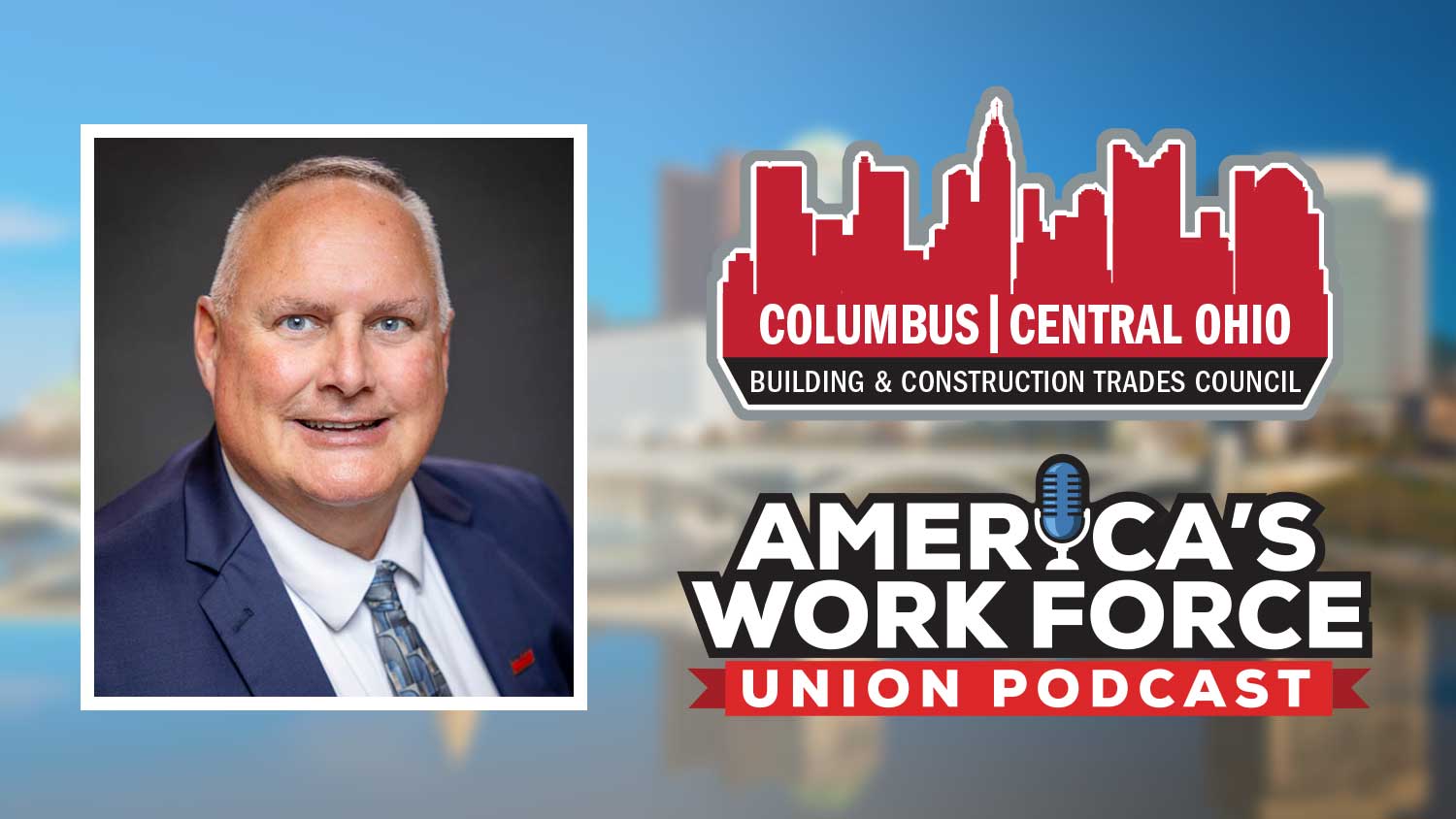
Dorsey Hager, Executive Secretary-Treasurer of the Columbus/Central Ohio Building and Construction Trades Council, joined host Ed “Flash” Ferenc on the America’s Work Force Union Podcast on Feb. 6, with a clear message: Central Ohio’s construction pipeline is deep, the building trades are staffing up and the region’s next challenge is keeping infrastructure and power generation moving with the growth.
Intel update: nearly 1,000 on-site with more ramp-up coming
Hager said the Council continues monthly coordination with Bechtel and Intel as work on the $28 billion chip manufacturing project advances.
Despite delays driven by factors beyond the job’s control, including a major snow event that required extensive site cleanup, Hager reported that “close to a thousand” building trades members are currently working on the Intel site.
Bechtel is also preparing to ramp up, he said, with plans to add roughly 600 more workers between now and summer. That would push total manpower to more than 1,500.
Hager said the project is still tracking toward Intel’s stated goal of opening in summer 2031. He also noted the Council’s workforce development pipeline is feeding the job, including recent placements from the Building Futures program.
More than Intel: gas plants, datacenters and major public projects
Hager emphasized that the opportunity in Central Ohio extends well beyond Intel’s gates.
He pointed to a significant natural gas-fired power plant project that will provide behind-the-meter electricity for datacenters. The project broke ground in October and is nearing completion of the underground work. Hager said crews are expected to start coming out of the ground in the next four to six weeks with an aggressive schedule to have some engines producing power by October 2026 and all 12 engines online by March 2027.
He also cited additional long-range development, including a planned multi-datacenter project west of Marysville, expected to break ground in 2029 with a completion date in 2035.
On the public side, Hager said the C/COBCTCl is close to finalizing an agreement with the county for a $100 million early childhood learning center downtown. He also said a deal has been reached for a new municipal courthouse in Columbus that will be built with union labor, with a reported price tag of $325 million, a summer start and a 2029 completion target.
Apprenticeship demand is surging, and the pipeline takes time
With the region’s growth, Hager said, Local Unions are seeing record interest in apprenticeship programs.
He said IBEW Local 683 took in the most apprenticeship applications in its history in 2025. Other trades are seeing heavy demand, he noted, including Ironworkers Local 172, Plumbers and Pipefitters Local 189, Sheet Metal Workers Local 24 and Insulators Local 50.
Hager said the C/COBCTCl is working to educate community partners and elected officials about what it takes to enter a registered apprenticeship.
“These careers are so highly lucrative,” he said, adding that applicants should expect background checks, drug testing and a competitive process that can take weeks or months. Even with those realities, Hager said the trades are meeting labor demand and continuing to scale.
Datacenters and the power question: messaging matters
Ferenc asked about concerns that datacenters consume large amounts of electricity and can put pressure on the grid.
Hager said the power issue is real but solvable, and he expects more on-site generation to come online, including natural gas and potentially hydrogen. He said that the shift could create significant work for the mechanical trades and electricians while reducing strain on the broader grid.
He also shared a point he said came up in conversations with Google: in some rural areas, new investment can bring the transmission and power upgrades needed to reduce brownouts for residents.
Hager added that the jobs story around datacenters is often misunderstood. While a company may cite a limited number of direct, permanent jobs, construction and maintenance work are ongoing. Datacenters require continuous upkeep and frequent retrofits, sometimes every 18 to 36 months, as technology changes and operators push for efficiency, he added.
NABTU Leaders Conference and a major 2028 win for Columbus
Hager also recapped the annual NABTU Leaders Conference and said the national conversation included both opportunities and threats.
He cited continued focus on infrastructure investment, along with concerns about paused projects and funding uncertainty that could impact building trades jobs.
Hager also highlighted a significant announcement for Central Ohio: Columbus will host the 2028 Tradeswomen Build Nations conference. He said the event will bring thousands of tradeswomen and building trades leaders to the city and deliver a significant economic impact for local businesses.
Re-election and the C/COBCTC’s focus: protect the treasury, grow market share
Ferenc congratulated Hager on being re-elected C/COBCTC Executive Secretary-Treasurer.
Hager said he believes the Council’s leadership team is aligned on two core responsibilities: protecting the treasury and increasing market share.
He said Central Ohio is experiencing construction activity that would have been hard to imagine in prior years, estimating roughly $160 billion in construction dollars in the region as of February 2026.
Hager also emphasized coordination across the Council’s leadership and affiliates, including political education and advocacy on issues such as Prevailing Wage, So-Called “Right to Work” and Project Labor Agreements.
Listen to AWF
Hager said he remains optimistic about the region’s momentum and the opportunities ahead for working families across Central Ohio.