
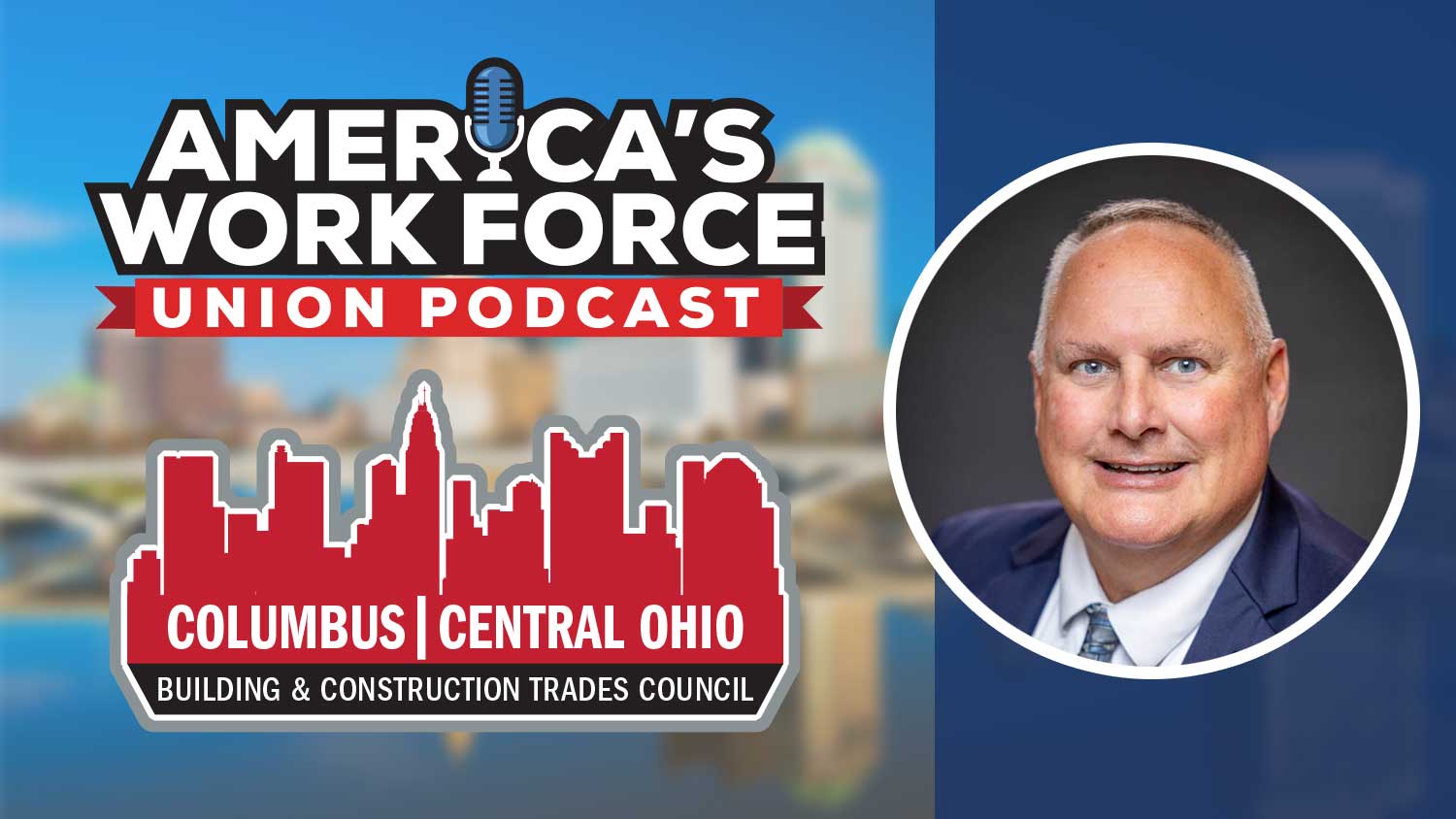
Dorsey Hager, Executive Secretary-Treasurer of the Columbus/Central Ohio Building and Construction Trades Council, joined host Ed “Flash” Ferenc on the America’s Work Force Union Podcast on Dec. 5, for the final Central Ohio update of 2025, highlighting significant jobsite progress, the realities of winter work and the council’s push to grow the workforce pipeline for projects expected to last into the next decade.
Winter work: “5 degrees” and the reality of earning a living in the elements
Ferenc opened the segment, noting the brutal cold facing building trades members.
Hager said he saw temperatures around 5 degrees that morning and immediately thought about members working long shifts outdoors, including on solar fields, datacenters and early-stage projects exposed to wind.
He credited workers for what they do to provide for their families and noted that while technology such as heated vests, improved gloves and cold-weather gear helps, Ohio winter conditions still make the work difficult.
Jobsite tour with NABTU: Intel, Vantage, Honda and the Hollywood Casino Hotel
Hager said representatives from NABTU visited Central Ohio recently to conduct member surveys and get a firsthand look at the region’s workload.
Hager selected several significant projects for the tour:
- Intel in New Albany
- Vantage Data Centers has a $2.1 billion campus with three data centers
- Honda’s electric vehicle battery plant, a $5 billion project
- Hollywood Casino Hotel, a six-story hotel project with roughly 260 rooms, is adjacent to the casino
Vantage Data Centers: three buildings moving in sequence
Hager said the first Vantage building is nearly complete, the second is around 30 percent complete and the third is coming out of the ground.
He credited Turner for keeping the work moving in a way that maintains continuity for the trades, shifting crews from one building to the next instead of creating layoffs between phases.
H-L Battery Company, Inc. plant: “We are going to hit our goal”
Hager said the H-L Battery Co. battery plant is on track to meet its end-of-year target.
He also said the project team secured additional work beyond Dec. 31, with Turner, Yates and Kokosing Industrial (TYK) awarded another half-million man-hours. Hager said that work could include closeout, maintenance and additional buildout.
Hager emphasized the long partnership with Honda and thanked leadership for the relationship.
Hollywood Casino Hotel: on schedule but “frigid” in the elements
Hager said the Hollywood Casino Hotel project is scheduled for completion in March 2027 and is currently on time.
He noted the job is still exposed to the elements as crews work to close in the building, calling it a “frigid” site until windows and enclosure are fully in place.
A region changing fast: Amgen, Meta, PharmaVite and power projects
Hager said the NABTU visitors had not been to New Albany since Intel’s groundbreaking in September 2022, and they were struck by the scale of the development.
During the drive, Hager pointed out multiple projects and expansions, including:
- Amgen, undergoing a $900 million expansion
- PharmaVite
- Meta’s second campus
- Power and data infrastructure projects supporting datacenters, including behind-the-meter generation
Hager said the visit was also valuable for sharing experiences with other markets across the country and for his own perspective.
He added that on days when the weather allows, walking jobsites in boots and a hard hat remains one of the most rewarding parts of the role.
Why NABTU visits: member surveys, safety and what workers want
Ferenc asked whether these visits are typical and what NABTU is trying to accomplish.
Hager said the strategy includes direct interaction with members and collecting feedback through quick online surveys shared via QR codes.
He said the surveys focus on issues that matter to members, including:
- Safety and jobsite protections
- How organized jobsites are
- Schedules and working conditions
- Working in the elements
Hager said the goal is consistent with what members want most: a safe job, good wages and benefits and the ability to go home at night and be with their families.
He also noted that Central Ohio’s boom is attracting travelers from across the country, including from areas where the job market is slower.
Workforce development: monthly meetings, mapping projects and organizing now
In the second segment, Ferenc asked about workforce development, noting that the region will need more workers for years to come.
Hager said the council’s affiliated unions are referring apprentices, journeymen and travelers to projects that are just breaking ground, and that some projects will run for 8 to 12 years.
He said Eli Wenzel, who leads outreach and the Building Futures Apprenticeship Readiness Program, is helping coordinate workforce development meetings.
Hager said the meetings are held on the second Wednesday of every month and include business managers, agents and organizers from around Central Ohio.
He said the Council is focusing on:
- Outreach in schools and communities
- On-site organizing on active projects
- Project mapping and manpower forecasting
Hager said organizers are using a mapped view of projects in western Licking County to plan jobsite visits and identify open-shop work.
He pointed to the airport as an example of a large project likely to involve significant non-union participation and said organizers intend to be consistently present.
Hager also said the current climate is ideal for organizing because workers can be organized and placed quickly, sometimes within a day, onto projects that may last years.
Guidance counselors on the jobsite: showing what modern construction looks like
Hager said that after a workforce development meeting, he and Sheet Metal Workers representative Scott Hill visited the Vantage site, where Turner hosted about 35 high school guidance counselors.
Hager said the tour helped counselors see the scale and professionalism of modern jobsites, including improvements such as heated lunch areas, heated restrooms and paved parking lots.
He said that firsthand exposure helps counselors better explain the opportunities in the trades to students.
Why the shift is accelerating: college cost, better conditions and strong wages
Ferenc noted that schools appear to be waking up to the value of the trades.
Hager said the shift is being driven by three factors:
- The rising cost of college and student debt
- Improved jobsite conditions and technology
- The wages and benefits available after completing an apprenticeship
Hager shared a statistic he said illustrates the college pipeline reality: out of nine students who attend college, seven return after freshman year, five graduate and two work in the field tied to their degree.
He contrasted that with the trades, where apprentices can top out in their early 20s, earning strong wages with no college debt.
Closing
Hager said Central Ohio’s construction machine “keeps rolling” and that the council’s priority is ensuring the workforce is ready to meet demand while continuing to improve jobsite standards and expand opportunity for working families.