
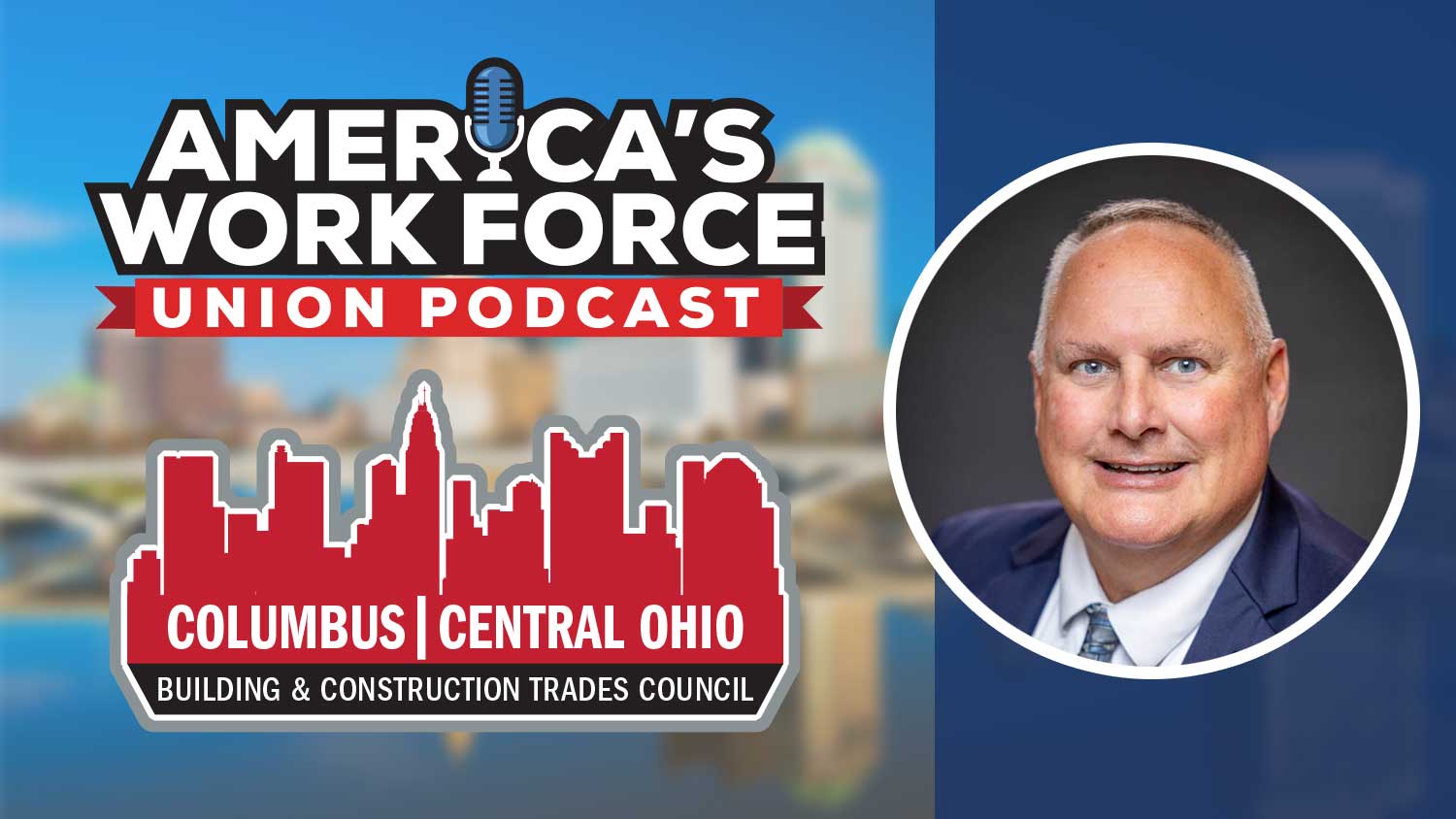
Dorsey Hager, Executive Secretary-Treasurer of the Columbus/Central Ohio Building and Construction Trades Council, joined host Ed “Flash” Ferenc on the America’s Work Force Union Podcast on Nov. 7, as election results rolled in nationwide and a federal government shutdown continued to squeeze working people.
Hager offered a detailed recap of Central Ohio’s local races, a broader read on national turnout and messaging and a warning that a prolonged shutdown could threaten infrastructure and clean energy work. He also recapped the Ohio State Building Trades Convention and the state-level leadership transition.
Election night: local races decided by inches and major wins for pro-labor slates
Hager said he followed the results closely while attending a conference in Florida and described himself as a “political nerd at heart.”
In Columbus, he said three city council members — Chris Wyche, Emmanuel Remy and Council Pro Tem Rob Dorans (an IBEW Local 683 member and Affiliated Construction Trades Chief Legal Counsel) — won unopposed.
The most competitive Columbus race, Hager said, was the District 7 seat where Tierra Ross faced challenger Jesse Vogel. Hager said Ross won by roughly 1,600 votes after a tight count that was not settled until the final precinct reported.
Hager said early fundraising indications showed both campaigns raised substantial sums, with Vogel’s campaign raising just over $375,000 and slightly more by Ross.
He also highlighted several other Central Ohio outcomes:
- Truro Township Trustee: Dennis Nicodemus, former IBEW Local 683 President, was re-elected
- Johnstown-area race: A young candidate Hager supported lost a City Council race by 16 votes
- Columbus City Schools Board: Patrick Katzenmaier, Dr. Antoinette Miranda and Dr. Jermaine Kennedy won open seats
- Canal Winchester City Council: Hannah Detweiler won her first race
Hager said these results underscore a point he repeats often: local races matter and can be decided by a handful of votes.
National takeaway: turnout, affordability and the message that moved voters
Hager said Democrats appeared to regain footing by running on an economic message focused on affordability.
He pointed to the high turnout in New York City’s mayoral election, noting that turnout surpassed 2 million for the first time since 1969. He also cited exit-polling details discussed by national commentators, including that 17 percent of voters were first-time voters and 11 percent were ages 18 to 29.
Hager said, regardless of where voters land ideologically, campaigns that stay disciplined on the economic pressures facing working families are worth studying heading into 2026.
He also criticized low turnout in off-year elections and cited Franklin County as an example: 67 percent turnout in the prior presidential year compared to 24 percent in this off-year cycle.
Hager stated many voters can name federal officials but cannot name local officeholders, even though city councils, township trustees, school boards and judges can shape economic development, public education and everyday life.
He also cited a statewide trend among school boards, noting that Democrats won 72 percent of school board races in Ohio. He highlighted Southwest City Schools, where Democrats swept seats and defeated Moms for Liberty-backed candidates, who he said went 0-59 statewide.
Shutdown impacts: clean energy cancellations and infrastructure uncertainty
Ferenc asked how the ongoing government shutdown is affecting construction.
Hager said clean energy projects are being canceled, and building trades members are being laid off in multiple areas.
He said the Intel project in New Albany is still moving forward, but not at the pace many expected. He said there are roughly 700 to 800 tradespeople onsite and that earlier expectations of 6,000 to 8,000 workers has not materialized.
Hager said his biggest concern in Ohio is the impact on infrastructure funding and delivery.
He explained that Central Ohio’s growth projections require major infrastructure upgrades, including roads, bridges, and water and wastewater treatment facilities. He cited upcoming discussions around a $2 billion water treatment facility north of Columbus, a similar facility northeast of Columbus and renovations at the Southerly wastewater plant on the southeast side.
Hager estimated those three projects represent roughly $6.5 billion in work, translating into significant man-hours and wages and benefits for local workers.
He said the shutdown had reached day 37 and expressed concern that the sides did not appear to be moving toward a resolution.
Ohio State Building Trades Convention: leadership transition and 2026 focus
Hager also recapped the Ohio State Building Trades Convention and the passing of the torch from longtime leader Mike Knisley.
He said Mark Douglas (IBEW Local 306 in Akron) stepped into the Executive Secretary-Treasurer role and Bobby Cole (UA Local 577 in Portsmouth) became President.
Hager listed the convention featured speakers, who focused on elections and pro-labor policy, including:
- Austin Keyser (IBEW)
- Derrick Kualapai (UA)
- Tim Burga and Melissa Cropper (AFL-CIO)
- Jay Edwards, a pro-labor Republican running for Ohio Treasurer
- Allison Russo, whom Hager said was instrumental in supporting building trades concerns tied to the airport
Hager also reiterated his support for Jay Edwards in a contested primary against Christina “Christy” Regner, whom he described as consistently anti-union.
A Mike Knisley story: “Let the grass grow another day”
Hager shared a story he said reflects Knisley’s leadership.
During negotiations to secure a significant project with Honda, Hager said Honda’s leadership requested a meeting with the head of the state building trades. The timing conflicted with Intel’s groundbreaking, so Hager scheduled the meeting for the evening.
Hager said he called Knisley on the way to the groundbreaking and asked what he was doing that night.
Knisley replied that he usually mows grass on Friday nights.
Hager said he told him, “Not tonight,” and that Knisley joined him to help finalize the agreement, helping get the deal “over the goal line” and securing work for thousands of union members.
Closing
Hager reinforced two realities: local elections can turn on a few votes, and federal dysfunction can quickly threaten job pipelines.
He said the building trades will continue pushing for pro-worker candidates, stable infrastructure investment and the kind of project delivery that keeps Central Ohio growing.