
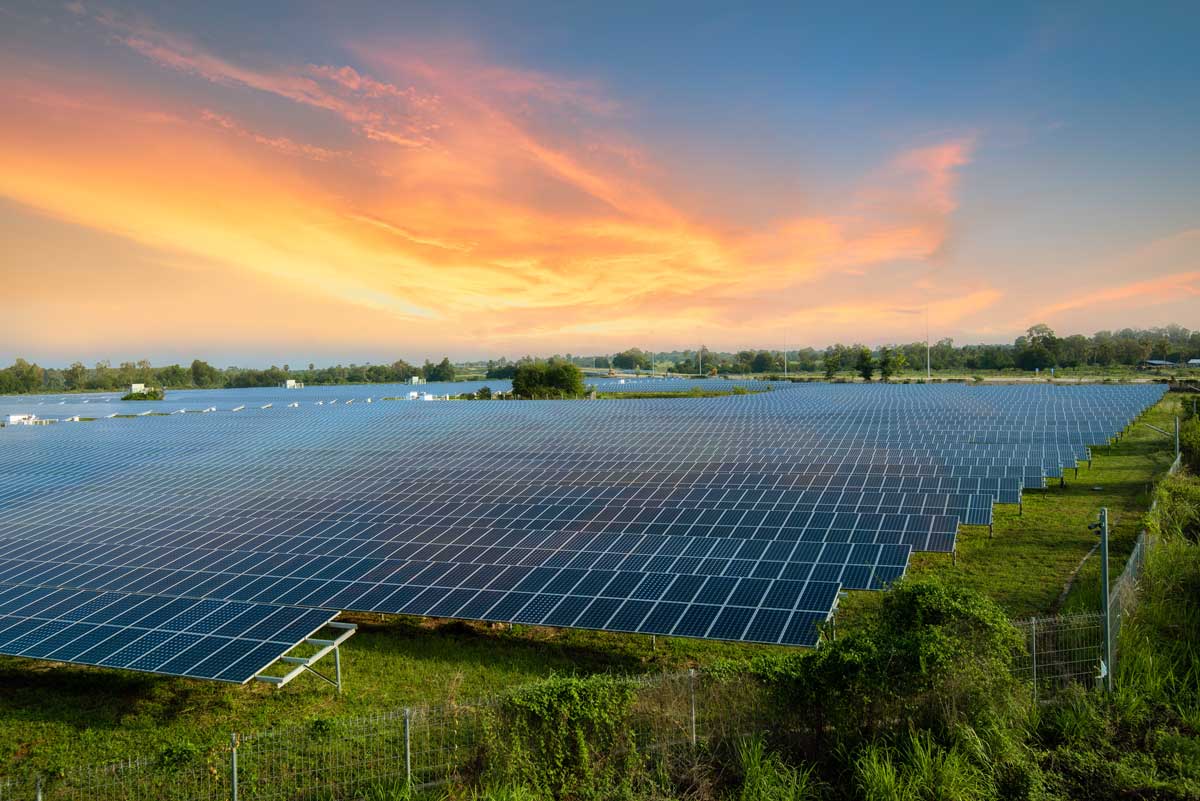
A case before the Ohio Supreme Court could define public interest, and the outcome may affect future solar farm projects throughout the state.
Justices heard arguments on Jan. 6 on how to define public interest, a criterion state law requires the Ohio Power Siting Board to consider when approving large projects.
At the heart of the issue is whether solar farm projects serve the public interest.
According to an article in The Cleveland Plain Dealer, justices are weighing how to balance local concerns with statewide needs and whether general political opposition to solar should factor in.
For members of Ohio building trades unions, the decision could affect future projects, some of which could create jobs for union members.
There are currently three solar fields being built in Central Ohio, with five more in the preconstruction phase.
Columbus/Central Ohio Building and Construction Trades Council Executive Secretary-Treasurer Dorsey Hager said these projects provide much-needed energy to the region.
“Solar creates a lot of job opportunities for members of the IBEW, Operating Engineers, and Laborers,” he said. “It provides clean energy for the AI datacenters and other projects. It keeps us in the mix for all of these types of projects and more.”
While not all solar work goes union, when it does, it is generally performed under a tripartite agreement between IBEW, Laborers and Operating Engineers.
“These projects create very steady, good work for our members 5-10s or 6-10s,” Hager noted.
He emphasized the need for better messaging to convince people that opposing solar and gas plants is not helping to lower electric rates.
“Its NIMBYism,” said Hager. As Parkersburg-Marietta Building and Construction Trades Council Business Manager Buddy Malone says, “Its the cave dwellers coming out in full force citizen against everything.”
A ruling in favor of local opposition could cost the state millions of dollars.
The case stems from a November 2024 ruling by the OPSB, which denied the application of Circleville Solar to build a 70-megawatt solar farm on about 1,300 acres in Jackson Township in Central Ohio. In denying the application, the OPSB claimed the project did not serve the public interest, convenience and necessity.
Now, the case could determine if other solar projects could be subjected to the same fate.
What the justices are weighing
As reported by WOSU, the plaintiffs attorney argued that public interest should be redefined.
Ryan Richardson, attorney for Circleville Solar, said the power siting boards rejection relied solely on local opposition and called the process meaningless if the local government does not support the project.
According to The Plain Dealer, Richardson argued local opposition should not be enough to block a project, as community concerns should be weighed alongside statewide benefits. He told the justices that political resistance to solar should not be treated as public interest.
Attorney Jack Van Kley, representing both the OPSB and Jackson Township, said the denial of the application was not based solely on public opinion.
The board did not treat this as an opinion poll, he said. The board did not base this on what the local governments thought.
Assistant Attorney General Robert Eubanks, representing the siting board, explained that the OPSB must look at the benefits of the project and its impacts, including local government opposition.
What the appellants want in this case is for the impacts to be ignored, for local government opposition to be ignored, said Eubanks.
The Circleville case comes on the heels of justices hearing oral arguments in November on the Fountain Point Solar Energy project.
In September 2024, the OPSB approved a 280-megawatt solar farm covering about 2,100 acres in Logan County’s Bokescreek Township. Those opposed to the project appealed the approval, challenging how the public-interest test was applied. The Plain Dealer reported the group also questioned safety planning and raised possible conflicts of interest.
Additionally, justices delivered a Christmas Eve ruling in favor of a Hancock Solar Farm, upholding the OPSBs approval of a 130-megawatt solar project on about 700 acres in Hancock County.
Meta: An Ohio Supreme Court case on how to define public interest could shape the future of solar farm approvals statewide with major implications for Central Ohio projects that provide energy for datacenters and steady work for union building trades members.