
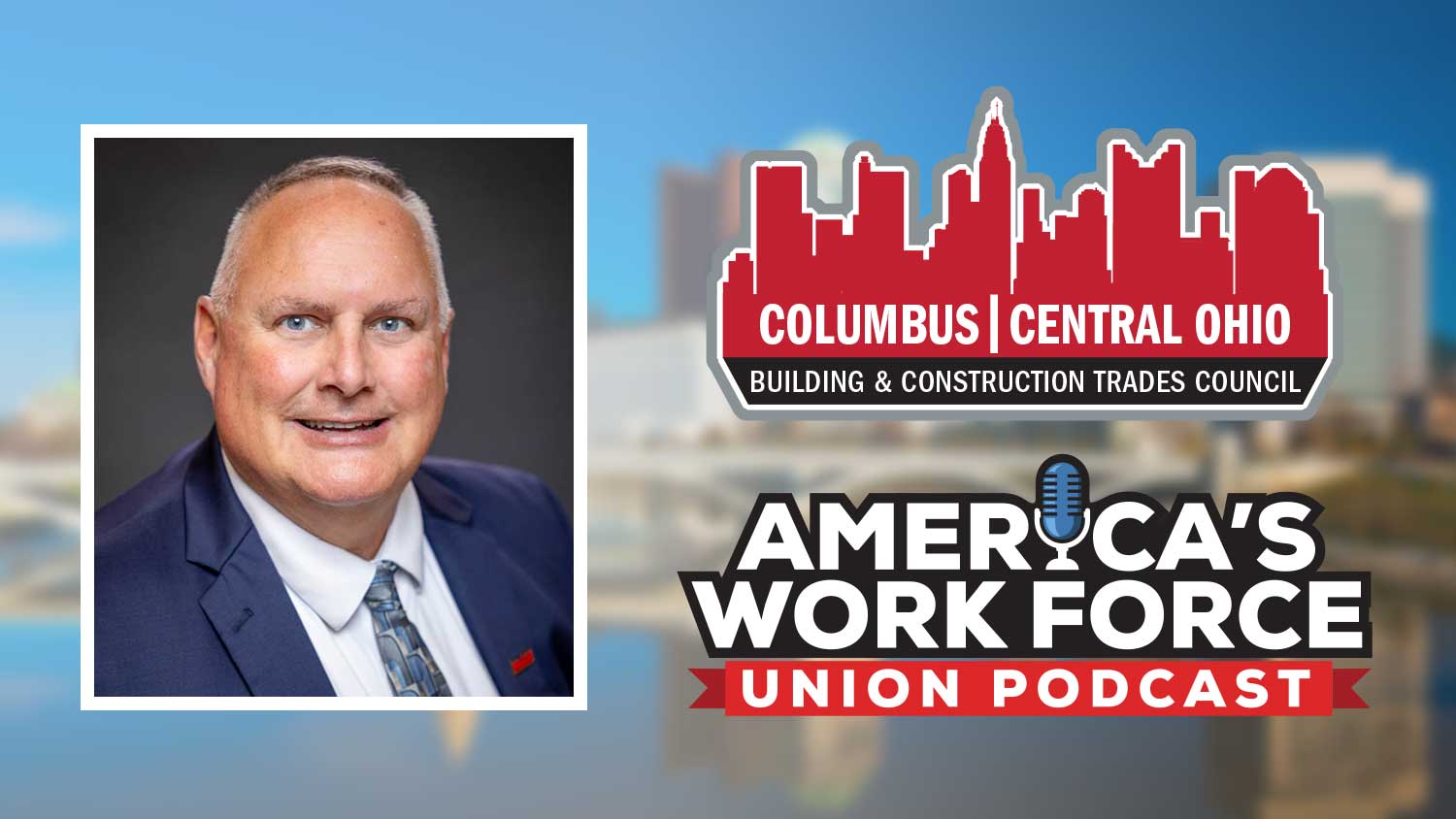
Dorsey Hager, Executive Secretary-Treasurer of the Columbus/Central Ohio Building and Construction Trades Council, joined the America’s Work Force Union Podcast from Las Vegas, where he was attending the Yotta Conference, a national gathering focused on data centers, AI infrastructure, hyperscale energy and behind-the-meter power generation.
He shared what developers and contractors at the event are saying about Ohio and laid out the record workload Central Ohio’s building trades are carrying. Hager also responded to reports that Honda may build a new plant in Union County. He also explained why he believes suspending Ohio’s gas tax is the wrong move for a region expected to double in size by 2050.
Ohio draws attention at a fast-growing data center conference
The Yotta Conference has expanded quickly in its four years. Attendance started at 1,500, climbed to 3,000 last year, which was enough to outgrow its venue, and reached roughly 6,500 at Caesars Forum this year. Organizers are moving the event to a larger site next year and expect the crowd to keep growing.
For Hager, the conference has been a chance to meet face-to-face with the companies shaping the industry: hyperscalers, developers, builders, behind-the-meter energy providers and multinational general contractors. Some, including Kiewit, Bechtel and Turner, already have work in Columbus and Central Ohio. Others have no presence in Ohio yet, but are monitoring the Buckeye State. Several have asked Hager for one-on-one meetings about the local labor climate, the size of the skilled workforce and what the Central Ohio building trades can deliver.
A few topics came up repeatedly in those conversations: community pushback against data centers, the case for developers to talk openly with residents early rather than show up with non-disclosure agreements, the national shortage of skilled craft workers, and the influence elected officials have over whether projects move forward.
What communities gain when they say “Yes”
Hager pointed to two places where data centers have paid off for residents. In Louisiana, a data center has committed $50,000 toward the salary of every teacher in the local school district. In Northern Virginia, Loudoun County hosts a higher density of data centers than any other jurisdiction in the country and collects about $1.2 billion a year in related tax revenue. That money has paid for new roads, bridges, water systems, schools, pools and parks. Hager said residents who once opposed the facilities came to support them after seeing what the revenue built.
Who should pay for grid upgrades?
Hager pushed back on the argument that data centers are the reason household electric bills are climbing, stating the factual support for that claim is thin. Utilities are upgrading the grid to handle new demand and passing part of that cost to customers, but he said the deeper problem is decades of underinvestment. Companies in Ohio have shut down power plants without building replacements, and grid capacity has not kept up with population growth, especially in Central Ohio. Add rising fuel costs to those existing gaps, and every bill goes up.
His solution is for developers to cover the costs of grid improvements their projects require, rather than shifting that burden onto ratepayers. Hager cited Google’s data center project in Scioto County as an example of doing it right. Since Google has committed to keeping the grid reliable, the summer brownouts the county has dealt with should end once the facility comes online.
Hager also expects battery storage to become a bigger part of the discussion in the months ahead. Storing surplus electricity and drawing on it during peak demand would reduce the time behind-the-meter gas turbines need to run, lowering both fuel use and emissions.
Central Ohio building trades on track for a record year
Ten years ago, Central Ohio’s union tradespeople logged 4 million work hours. Three years ago, the total reached 10 million. This year, the trades are on pace to surpass 20 million hours, setting a new record.
Google is a big part of that story. Its three Columbus-area campuses generated 6.5 million hours of new construction and maintenance work last year and employed about 4,000 area building trades members at wages and benefits that support their families.
Even so, Hager said the trades cannot let data centers overshadow their other markets. Roughly $2 billion in healthcare construction is underway across Columbus, from $30 million clinic expansions to a $780 million hospital project. The Ohio State University, state government facilities, commercial projects and public schools continue to provide significant work, and Hager said keeping those long-standing relationships strong during the data center surge is a priority.
Honda reports put Union County in the spotlight
While in Las Vegas, Hager read reports that Honda is considering building a new car plant in Union County. The Japanese media outlet Nikkei broke the news, which was then picked up by The Columbus Dispatch and the Associated Press. Hager, who lives in Marysville, Honda’s Ohio home, stressed that nothing has been confirmed.
The building trades and Honda have worked together for more than 50 years. Members recently completed the L-H Battery Plant, and talks are underway for a Project Labor Agreement covering $300 million in upgrades to the facility. Hager said Honda has turned to PLAs for its large-scale projects because it knows union craftworkers build safely, on time and under budget. His first priority after returning home is to meet with Honda officials, learn more about their plans and ensure the building trades remain their partner.
A growing region needs more infrastructure investment, not less
Columbus is projected to double in population by 2050, and Union and Delaware counties, just north of Franklin County, consistently rank among the 10 fastest-growing U.S. counties per capita. Hager said the building trades are adding members in every craft to meet demand.
Growth on that scale also requires sustained city and state spending on roads, bridges and highways. In Hager’s view, Ohio’s transportation budget should grow alongside the population rather than shrink, and the members who build that infrastructure have a direct stake in the outcome.
Why Hager calls the gas tax suspension bad policy
The proposal to suspend Ohio’s gas tax was announced at a press conference held by the Speaker of the Ohio House and the Ramaswamy campaign. Gov. Mike DeWine estimated the move would pull about $750 million from the state transportation budget, but he has since signed the bill, putting an immediate 90-day suspension into effect.
Hager called it a bad policy. With Columbus growing rapidly, the electrical grid needing major investment and roads and bridges struggling to keep pace, he said that giving up $750 million in infrastructure funding for pennies-per-gallon savings is the wrong trade-off, and the lost investment could affect projects and jobs for years.
He also described the proposal as a political reaction to a tight governor’s race. A recent Marist poll of likely voters found Democrat Dr. Amy Acton leading Republican Vivek Ramaswamy by 6 points, even though Ramaswamy’s campaign has outspent Acton by roughly 6 to 1. Hager added that President Trump’s approval rating, which he put at about 32 percent, has complicated the Republican path in Ohio.