
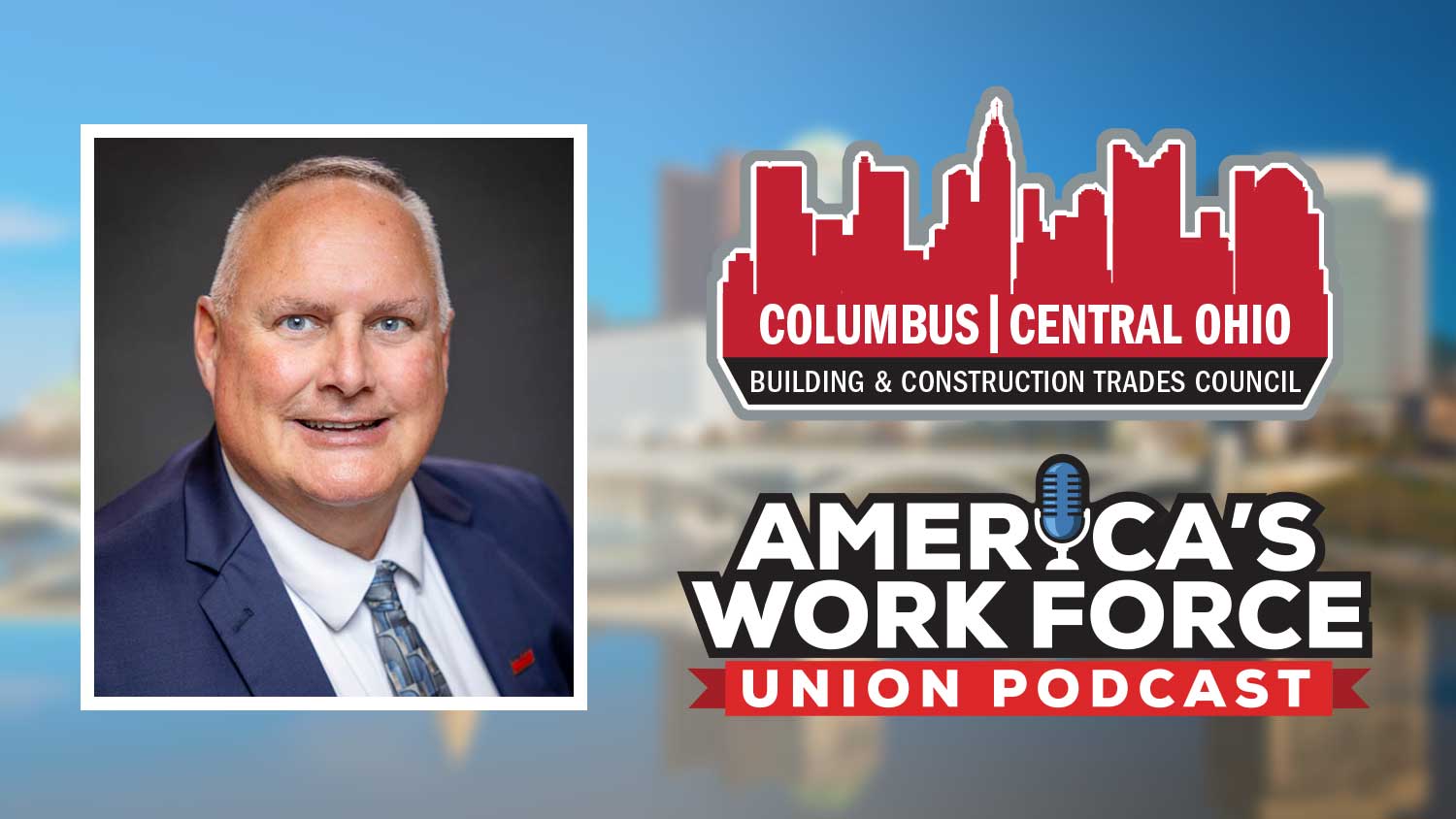
Dorsey Hager, Executive Secretary-Treasurer of the Columbus/Central Ohio Building and Construction Trades Council, joined host Ed “Flash” Ferenc on Sept. 3 for his monthly Trades Day segment on the America’s Work Force Union Podcast.
He described labor’s recent strong showing at two Ohio Power Siting Board hearings and what he told a Millersport resident who opposed one of the projects. Hager also questioned whether Central Ohio’s infrastructure is ready for the growth ahead, previewed an IBEW job blitz in Columbus and looked ahead to the 2026 and 2027 elections.
Labor turns out for two Ohio Power Siting Board hearings in one week
Hager spent the Monday before the episode in Millersport, a Fairfield County community near Buckeye Lake, where the Ohio Power Siting Board held a hearing on the Fairfield Energy Center application. The behind-the-meter gas plant would supply power to a more than $2 billion data center campus being constructed in the county.
Union members, business managers, agents and organizers from around Central Ohio came to testify in favor of the project. Hager said 30 people spoke in all, and 13 of the first 17 to address the board were union members or union representatives. They talked about the jobs the plant would bring, the apprenticeship openings it would create for people new to the trades and the years of maintenance work it would provide for experienced members.
Opponents cited concerns about air and water quality and their overall quality of life. Hager said he considers that NIMBY sentiment sincere and easy to understand, but it won’t stop the growth headed for Central Ohio.
Two days later, Hager was in Asheville for another Ohio Power Siting Board hearing, this one on for an energy center that would serve the EdgeConnects and PowerConnects data center campus. Work on the data center site is already moving, with trailers going in for workers. He said 70 people spoke, about half of them from labor, and the arguments on both sides mirrored what Hager heard in Millersport.
Hager’s message to opponents: growth is coming
After the Millersport hearing, a longtime resident who opposed the project caught up with Hager outside, and the two had a friendly but frank conversation. Hager told him he understood the frustration. He also told him that anyone living in Franklin County or a neighboring county should expect to see construction nearby before long. That could mean a data center, an energy center, an Intel supplier, the Anduril drone manufacturing facility, new housing or a large solar installation.
Central Ohio is projected to add a million people by 2050, and the five- to six-county region will need roads, bridges, schools, churches, homes and businesses to support them. People who do not want to live with that growth, Hager said, may want to think about selling their homes.
Can Central Ohio’s infrastructure keep up?
Regarding the expected growth, Hager didn’t sugarcoat his view of the region’s infrastructure. Central Ohio is falling behind in building infrastructure to keep pace with its growth, and he isn’t sure it can close the gap in time.
The Interstate 70/71 interchange work has eased traffic downtown, but the project isn’t finished. The outer belt needs more lanes. A second, larger loop linking Delaware, Newark, Lancaster, Circleville, London and Marysville has been talked about for two decades with no progress. The $350 million Columbus municipal court building was recently canceled after federal and state cuts squeezed local budgets, and Columbus City Schools still has facility needs at every grade level.
Hager argued that infrastructure means much more than roads and bridges. Courts, schools, transit and every other system a city depends on is included within this definition. He was glad to see the first east-west corridor of the LinkUS bus rapid transit program get started, even though it’s still an open question whether it goes far enough. When asked whether Central Ohio is ready for a million new residents by 2050, Hager said it isn’t. He hopes the region gets there, but he isn’t confident it will.
Parents and students are seeing the trades differently
Eli Wenzel leads the C/COBCTC’s Building Futures program, which has widened its focus beyond young adults who are unemployed or underemployed after college. The council now visits middle and high schools to reach students before they’ve chosen what to do after graduation.
Hager has watched attitudes change over the past 12 years. Early on, many parents pushed back when the council talked to their kids about the trades. Now those same parents see tuition-free training, annual raises, industry-standard pay, full benefits and defined-benefit pensions, and they want their children, nieces and nephews to pursue those careers.
Young people are rethinking the path to adulthood, too. Fewer want to head straight to college given the cost, and the average first-time homebuyer is now close to 38 years old. Many would rather reach a six-figure income quickly and keep the option to go back to school later.
Hager knows that path firsthand. He once promised his parents he would finish his degree and become a teacher, but the trades kept him too busy and paid him too well to go back. Some of the people who were apprentices with him are already retiring after long, financially secure careers.
IBEW job blitz aims to place workers the same day
The IBEW is bringing a major organizing push to Columbus. Organizers from throughout the union’s Fourth District will visit active jobsites across the city, hand out leaflets and talk with non-union workers. An all-day event will follow, where interested workers can meet union representatives and contractors and leave with a job placement that same day.
If the blitz works, the UA may try something similar. Hager has already spoken with Ohio State Building Trades President Bobby Cole and Executive Secretary Mark Douglas about expanding the idea into a council-wide effort that includes every trade. His goal is simple: find the outreach that works, then repeat it and grow it.
Hardin vs. Ginther in 2027, but November comes first
Hager noted that Columbus City Council President Shannon Hardin, whose brother is a member of IBEW Local 683, plans to challenge Mayor Andrew Ginther in the 2027 mayoral race. He called both men strong friends of the building trades. Ginther won his last two re-election bids comfortably, while more than 1,200 people turned out for Hardin’s annual community fish fry, where he announced his run.
The C/COBCTC screens and endorses candidates in the election year, so its process for the mayoral race won’t begin until 2027. For now, the council is focused on the November 2026 election, including returning Sherrod Brown to the U.S. Senate, electing Amy Acton as governor and winning enough Ohio House and Senate seats to break the Republican supermajority.
Labor Day at 132 and a rising tide
Labor Day carries personal meaning for Hager’s family. He is the son of a pipefitter, and his wife’s father was a union coal miner who served as president of his Local Union in Eastern Ohio. Hager encouraged listeners to attend Organizing Columbus: A Labor Day Celebration at Columbus City Hall. The event is organized by City Council Pro Tem and IBEW Local 683 member Rob Dorans, where union members will talk about what their membership has meant to their families.
Hager’s Labor Day message is the same one he shares during every outreach conversation: a rising tide lifts all boats. The 40-hour work week, paid time off and vacation, workplace safety rules, pensions, annuities and healthcare programs all came out of the labor movement, and union and non-union workers alike benefit from them today.