
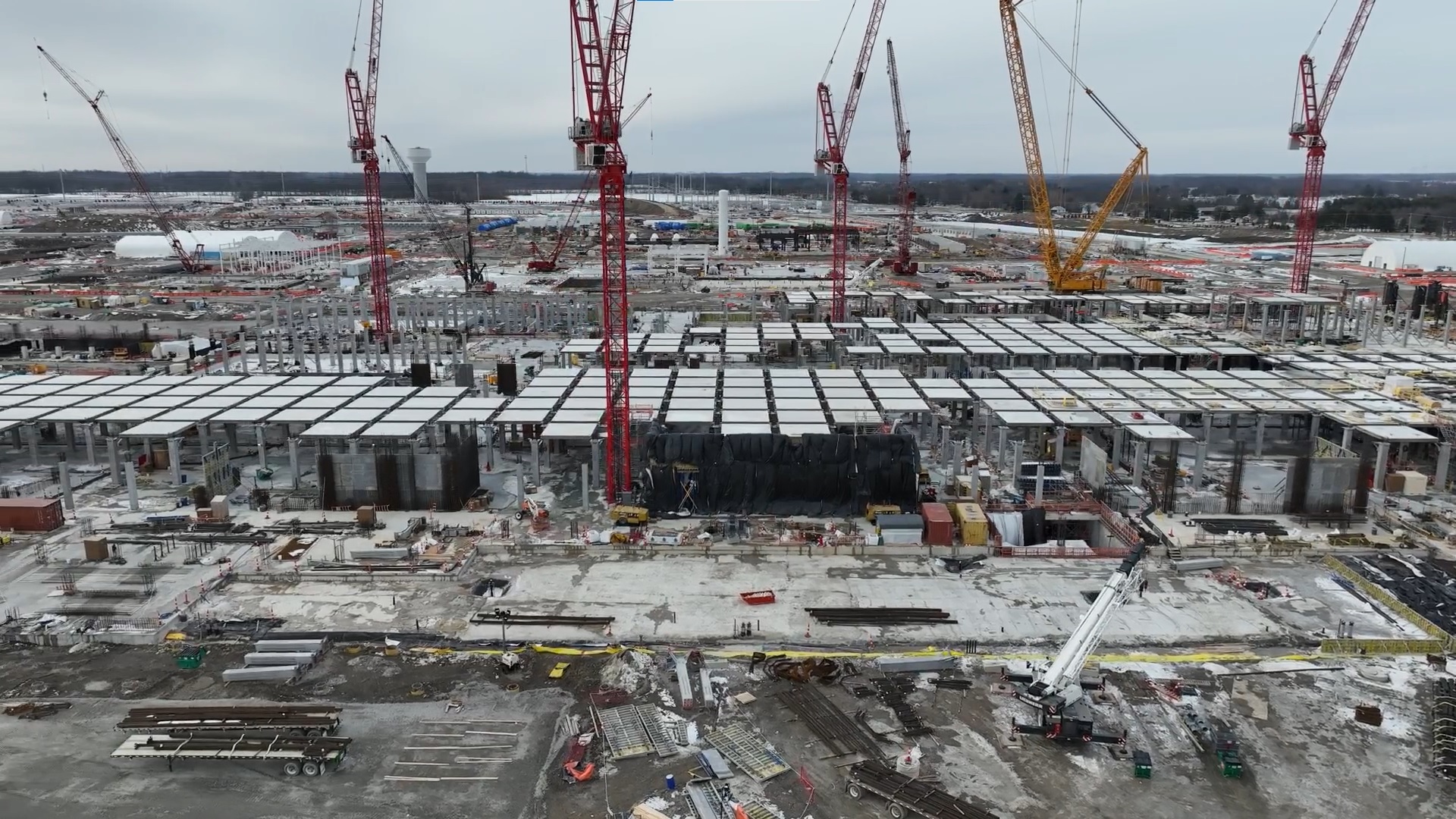
As part of its agreement for the economic development package offered by the State of Ohio, Intel completed its annual project update to the Ohio Department of Development.
According to The Columbus Dispatch, a Feb. 7 letter by Jim Evers, Intel Vice President and Ohio Site Manager, stressed that Intel was committed to its New Albany project.
“Ohio One remains part of our long-term plans for U.S. (microchip) manufacturing and we will continue to pace construction with customer demand,” he wrote.
$5.26 Billion Invested to Date
Intel stated the company spent over $1.5 billion last year on campus construction, increasing its total investment to $5.26 billion.
Of the $1.5 billion spent in 2025 at the New Albany campus, more than half — $938 million — went toward the first of two factory buildings, called fabs.
Evers noted that most of the construction work was focused on underground utility corridors, a boiler and chiller plant and water and power facilities. Two stories of steel were erected for the office building, and above-ground steel work also started on the separate boiler/chiller building and water purification plant. Installation work is complete on all major underground corridors in support of permanent site utilities.
As reported by Columbus Business First, roughly $1.75 billion in future contractual commitments have been made, bringing the total spend to approximately $7 billion for the planned $28 billion complex.
Building Trades Members at the Center of It
Evers noted that Intel will continue to prioritize the hiring of local building trades members on the megaproject. Since breaking ground, building trades members from 83 of Ohio’s 88 counties have logged over 10.1 million manhours to date.
A Project That Has Faced Headwinds
Since the project was announced, it has faced significant challenges. Congress failed to pass the CHIPS Act in a timely manner, and Intel experienced serious financial difficulties, with its stock bottoming out at $18.13 per share in early April 2025 — a 16-year low.
In late 2024, Intel CEO Pat Gelsinger was fired and replaced by new CEO Lip Bu Tan in 2025, who signed major investment agreements with the federal government, Nvidia and Softbank. As part of its deal with the Trump Administration, the U.S. now holds a 10 percent stake in the company.
Those financial issues have pushed back the project’s timeframe. Roughly one year ago, Intel Executive Vice President Naga Chandrasekaran announced the opening of its two Ohio fabs would be pushed back to 2031 and 2032. It was the second announced delay on what has been considered Ohio’s most prominent megaproject. A year earlier,
Revised Timeline
Evers stated the first fab is now scheduled to be completed in 2030 and become operational by 2031. The second plant, Ohio Two, should be completed in 2031 and operational in 2032.
According to Columbus Business First, terms of the state’s $600 million onshoring grant currently require Intel to spend at least $20 billion and create the promised 3,000 jobs by Dec. 31, 2028.
Ohio will have a new governor next year, who will be in place when the time comes to extend or renegotiate the deal if Intel cannot meet those requirements.