
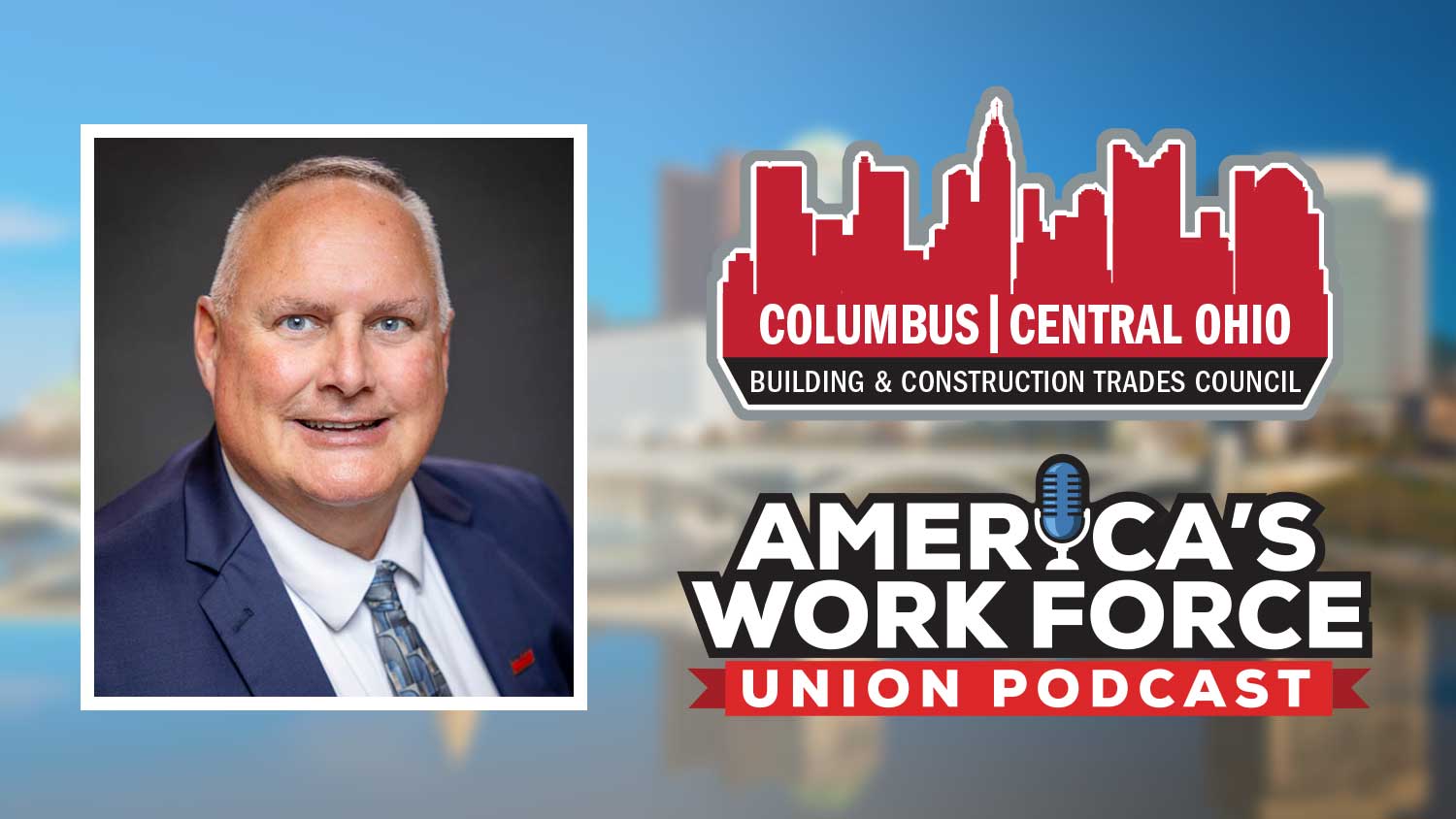
Dorsey Hager, Executive Secretary-Treasurer of the Columbus/Central Ohio Building and Construction Trades Council, joined host Ed “Flash” Ferenc on July 2 for his monthly appearance on the America’s Work Force Union Podcast.
Fresh off a round of jobsite visits, he shared progress at the Anduril drone manufacturing campus in Pickaway County, early work on a data center and power campus in Asheville and work at the John Glenn Columbus International Airport. He also explained how Central Ohio’s building trades are on pace to more than double the hours they worked when compared to three years ago.
A drone plant built in roughly 13 months
Hager often tours jobsites with Anthony Ciardelli, a business agent with IBEW Local 683. Some visits are planned. Others happen when the two notice new construction from the road and stop to check it out. A recent trip brought them to the Anduril drone manufacturing campus in Pickaway County.
Of the 12 buildings planned for the campus – called Arsenal-1 – the first has been completed. It has its occupancy permit, production is underway, and Hager said the first drone was expected to come off the line that week. Anduril holds contracts with the U.S. government, the United Kingdom and Australia for both reconnaissance and weaponized drones.
Crews who completed the first building have already moved to the second, a research and office facility where the steel is erected and the exterior walls are in place. Eighteen months earlier, Anduril had no footprint in Central Ohio. Getting its first building finished in about 13 months, Hager said, would stand out against any industry benchmark.
Groundwork begins on Asheville’s data center and power campus
The next stop was Asheville, where Power Connects and Edge Connects are building a data center campus paired with a power plant. Fencing surrounds the site; crews are grading the land; gravel deliveries are arriving; and temporary trailers have been set up. Hager expects underground work to start within 30 to 60 days, and area building trades have already begun dispatching members to the project.
An airport expansion keeps union crews busy
At John Glenn Columbus International Airport, ironworkers, laborers and operating engineers are on the job for the ongoing expansion. Union members are doing about 83 percent of the work. A few non-union contractors did win contracts, but Hager treats those as chances to organize. The trades are meeting those workers on jobsites and in the places they stop after a shift, from gas stations to restaurants and bars, to recruit them into Local Unions that need more manpower.
From 4.2 million hours to 20 million
The growth of Central Ohio’s building trades comes into focus when Hager lays out the numbers. Twelve years ago, when he was elected to his current role, affiliated members worked about 4.2 million hours. That figure topped 9 million three years ago. This year, members are on pace for more than 20 million hours.
Apprenticeships have grown alongside the work. Enrollment in the region’s Registered Apprenticeship Programs is up 68 percent over the past 10 years, and there are four times as many women in affiliated Local Unions as there were in 2016. Hager credits that growth to years of steady outreach in communities that had few ties to the trades.
Opening doors in Celebrate One neighborhoods
Much of that outreach now happens in Columbus’ Celebrate One neighborhoods, where unemployment and crime are high and workforce development resources are scarce. Affiliated unions are introducing residents to building trades careers and the apprenticeship programs that lead to them.
Hager’s pitch is that the trades offer a reliable way into the middle class. AI is wiping out jobs in data entry, administrative work and other computer-based roles. He pointed out that building trades work can’t be automated. Union members also earn good wages and benefits, which include healthcare for their families.
Why younger workers are turning to unions
Hager then addressed a union drive among nurses at a children’s hospital in Columbus. The nurses say long hours are hurting patient care and that weak security has exposed nurses and support staff to workplace violence.
He sees the drive as part of a larger shift. Younger workers who believe the American dream is moving out of reach have watched their parents and grandparents build secure lives through union contracts, and they want that same security.
Speaking two days before the 250th anniversary of the Declaration of Independence, Hager said he owes much of what he has to the labor movement and feels responsible for opening the same doors for others.
He called the national underemployment rate, now above 8 percent, an overlooked number. Low unemployment figures can make the economy look healthier than it is, he said, because many people are working below their skills or ambitions. Those are the workers the trades can help most.