
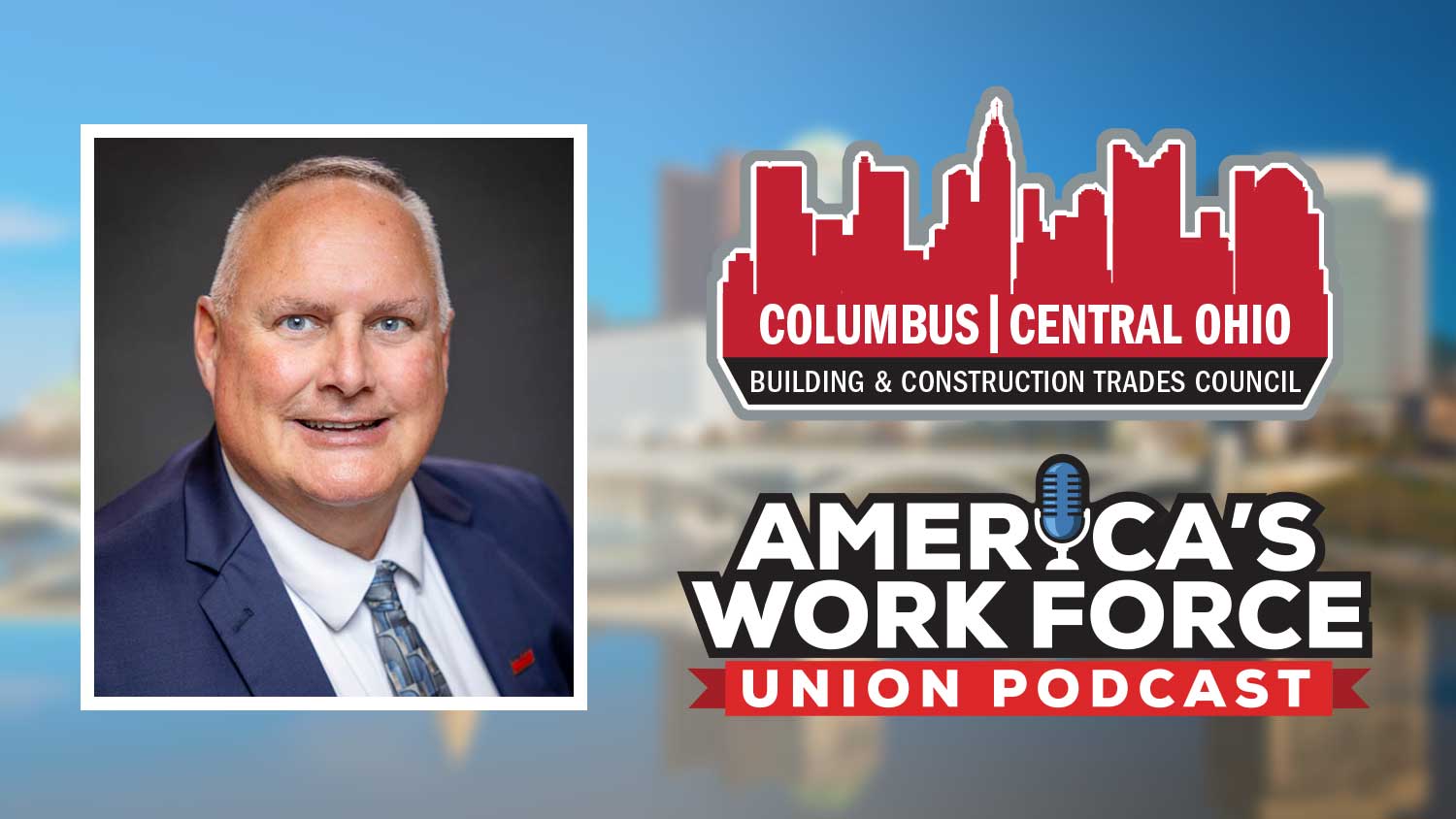
Dorsey Hager, Executive Secretary-Treasurer of the Columbus/Central Ohio Building and Construction Trades Council, joined host Ed “Flash” Ferenc on Aug. 6 for his monthly appearance on the America’s Work Force Union Podcast.
His top news was a newly finalized Project Labor Agreement for a $100 million early childhood learning center on the site of a former downtown Columbus jail. Hager also covered Springfield’s win of Electra’s $850 million aircraft plant, Intel’s steady progress, how local governments can get more out of data center deals and the building trades’ two days of outreach at the Ohio State Fair.
A $100 million early learning center on the site of the old jail
No project excited Hager more this month than the early childhood learning center planned for downtown Columbus. Franklin County will pay for, build and run the $100 million facility, which will serve children ages 3 to 5 on the site of the old downtown jail. About a decade ago, the county built its new correctional facility west of downtown for about $300 million under a separate Project Labor Agreement.
Franklin County Commissioner Erica Crowley has pushed for the learning center since her time in the Ohio Statehouse, before she ran for county commissioner. The C/COBCTC finalized its memorandum of understanding on a PLA for the project this week, which means union labor will build it and the work will be done safely, on schedule and within budget.
Hager pointed to research findings that each dollar spent on early childhood education saves about $9 in future incarceration costs, a return he linked to the low educational attainment common in the prison population. Preparing young children for elementary school, building their foundational skills and easing childcare costs for working parents pays off in urban, suburban and rural communities alike, he said.
The project will also create a path into the trades for people from underserved and underrepresented communities, whether they start on this jobsite or enter an apprenticeship program. Meanwhile, early discussions are underway on expanding the county’s jail. Hager estimated that the project could top $300 million, with a groundbreaking targeted for 2027.
Springfield wins Electra’s $850 million aircraft plant
Springfield finished ahead of 242 cities worldwide to become the home of a new Electra aircraft manufacturing facility. Electra plans to invest $850 million in a 96-acre plant at AirPark Ohio, next to the Springfield-Beckley Municipal Airport in Clark County. The site will build the EL9 Ultra Short, a hybrid-electric airplane, and create close to 2,000 jobs. While not within the C/COBCTC jurisdiction, Clark County sits two counties west of Franklin County. Hager called this area strong in aerospace, and he expects suppliers to follow the plant there, spreading its economic benefits well past the county line.
Intel keeps climbing as energy centers head to hearings
Construction on Intel’s Central Ohio campus continues to gain momentum. Hager said the company’s recent deals with Nvidia and Apple, along with its federal funding, are encouraging signs.
Besides the good news with Intel, two energy projects tied to the region’s data center growth are also approaching public hearings. The Fairfield Energy Center, a gas-fired plant, would power data center campuses proposed in Fairfield County and Millersport. The Asheville Energy Center, south of Columbus, would provide power for the data center construction already happening in Asheville.
Making data center deals work for small communities
Hager supports data center development and also lives in a community where data centers are going up. The C/COBCTC backs the industry, and the numbers explain why. Last year, Google’s three Central Ohio facilities alone produced 6.5 million work hours for building trades members, the equivalent of about 3,700 union jobs paying industry-standard wages with full health, pension and annuity benefits. Google, EdgeConnect, Amazon, Microsoft and Meta are among the companies building data centers in the region.
Where Hager sees a problem is in local government. Township trustees, village council members and county commissioners often work day jobs as farmers, accountants or lawyers. They are now sitting across the table from sophisticated developers to negotiate complex economic development agreements, and many lack the tools to secure the best outcomes for their communities.
Asheville shows what a strong deal can look like, he said. The village council negotiated a $110 million development agreement that includes a new fire station, a complete upgrade of water and sewage infrastructure capped at $34 million and roughly $50 million for local schools. After levies failed amid rising costs, the school district has been holding classes in trailers.
Hager acknowledged that data centers have contributed to rising utility prices, though other factors are also involved. He noted that Google is upgrading the electrical grid around its Portsmouth facility in Scioto County, where brownouts have been a problem during hot summers. Google has its own reason to fix it, since a data center can’t operate in an area prone to outages. State and federal discussions about making data center developers pay for the infrastructure their operations require are the right conversations to have, he said.
The AFL’s Columbus roots and a union Hilton
In keeping with AWF’s Labor 132 series, Hager shared a discovery he made while walking downtown with his wife. A historical marker at Fourth and Town Streets notes that the American Federation of Labor was founded there on Dec. 8, 1886, with Samuel Gompers elected as its first president. Hager now works that history into community education and into conversations with elected officials and partners about labor’s nearly 140-year role in Columbus and Central Ohio.
That legacy continues today. Commissioner Crowley partnered with Central Labor Council leader Jamie Shoemaker and the Franklin County Convention Authority Board to make sure the new 1,100-room downtown Columbus Hilton would be staffed by union workers. That helped bring the 2028 Tradeswomen Build Nations Conference to the Columbus Convention Center, where about 7,000 building tradeswomen are expected from across North America. And many will stay at a union hotel in the city where the AFL began.
Two days at the Ohio State Fair
Heat and all, Hager called the Ohio State Fair one of the best dates on the building trades calendar. During the fair, the Cement Masons host a statewide competition for apprentices and journeymen and invite the other trades to join them with booths, handouts and live demonstrations. Bricklayers laid up walls, and cement masons finished concrete while kids who had come for the food and rides stopped to watch and ask questions.
Hager was also there. He talked with teenagers who had never thought about a trades career, adults stuck in underpaid open-shop jobs and people curious about work at data centers and Intel. Many wanted to see how union pay compared to what they earn now, he said. One conversation showed exactly why the building trades show up. A young truck driver with a CDL, making about $25 an hour with no benefits, walked away from the fair already connected to the Teamsters.
Hager thanked Kitty French from Affiliated Construction Trades (ACT) Ohio and Eli Wenzel of the C/COBCTC for making the event a success. Few other outreach efforts reach as many people from as many different backgrounds as those two days at the fair.