
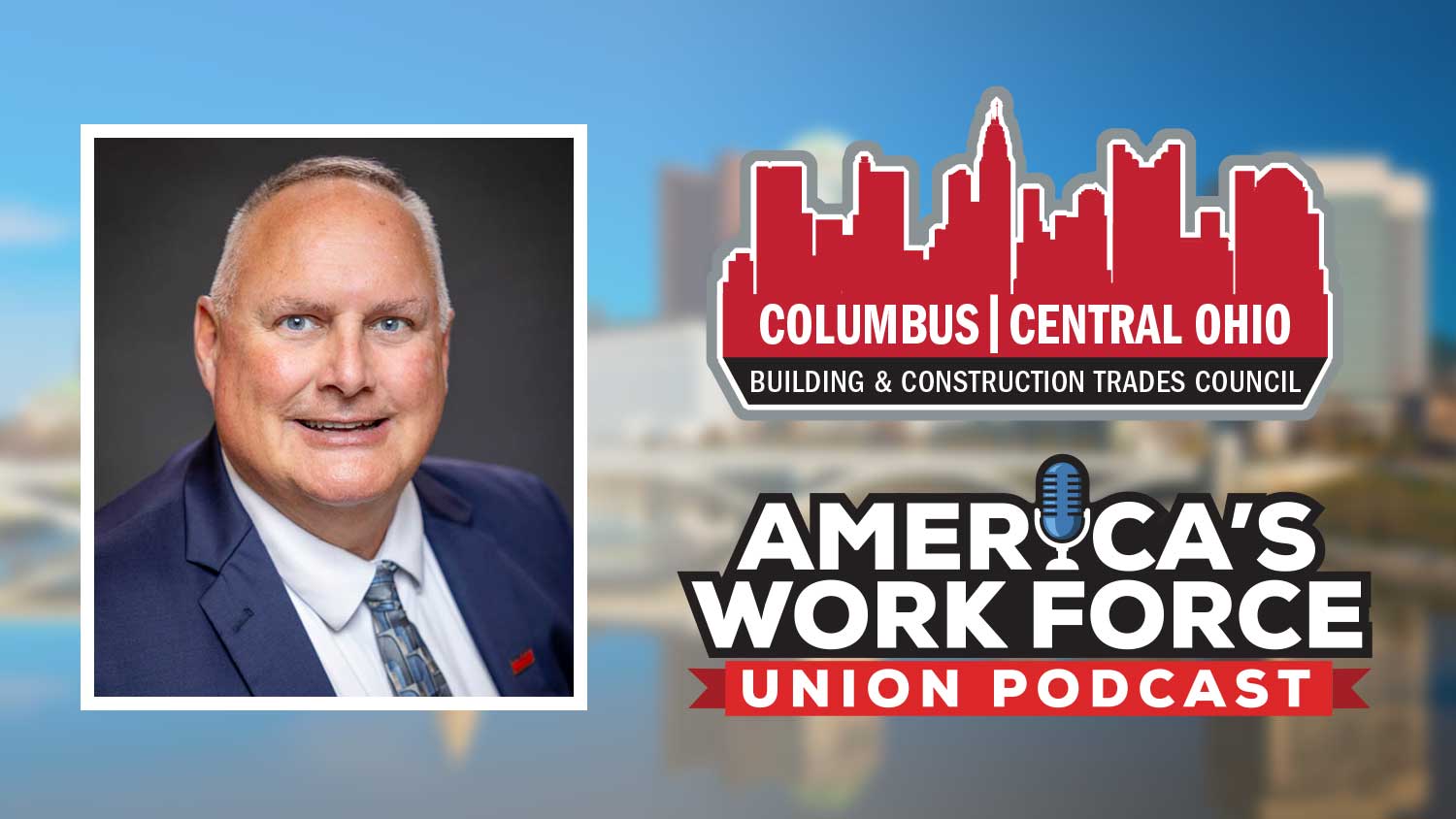
Dorsey Hager, Executive Secretary-Treasurer of the Columbus/Central Ohio Building and Construction Trades Council, joined host Ed “Flash” Ferenc for the May 1, May Day episode on the America’s Work Force Union Podcast. He provided updates on a massive apprenticeship outreach event and the continued push to educate communities on data centers and power. He also had time to provide some key takeaways from the NABTU Legislative Conference in Washington and a breakdown of Ohio primary races the building trades are watching closely.
Record apprenticeship outreach: nearly 1,000 show up for IBEW 683 event
Hager opened by highlighting a major apprenticeship outreach event in partnership with IBEW Local 683 during National Apprenticeship Week. The response far exceeded expectations. More than 1,000 RSVPs were received and nearly 1,000 people attended the two-hour event. By the time doors opened at 5 p.m., more than 300 people were already in line.
Representatives from multiple affiliated building trades Local Unions were on hand — including operating engineers, painters, plumbers and pipefitters, sheet metal workers and others. Attendees with a range of interests could speak with the right people to learn more about apprenticeship opportunities. More than 100 attendees were already working for non-union electrical contractors at hospitals or data centers and came specifically to compare wages and benefits, Hager said. This gave organizers from Local 683 an opportunity to make the case for the union advantage.
He credited 683 Business Manager Pat Hook, Training Director Trent Parker and organizers Aaron Adair, Chris Poff and Cesar Laroquent for driving the event’s success. He also noted a meeting with Sarah Ingalls, now legal counsel for the Ohio Democratic House Caucus and pro tem of the Columbus City School Board, to discuss expanding outreach into middle and high schools so that students and parents alike learn about building trades career opportunities earlier.
Hager said IBEW Local 683 and IBEW Local 1105 to the east are currently two of the fastest-growing IBEW locals in North America, fueled by the explosive demand for electricians across Central Ohio’s tech sector.
Electricians and data centers: a natural fit driving 40 percent of council hours
Ferenc asked whether electricians and data centers are essentially a perfect match. Hager said yes — and put a number on it. He said approximately 40 percent of all manhours worked by Columbus Building Trades members now come from data center work, with electricians in particular high demand for server work, security systems, fire alarm systems and related infrastructure.
He noted that younger apprentices and journeymen are proud to say they’re building at Meta, Google or Microsoft, seeing themselves as part of the effort to build the digital infrastructure that will help the U.S. compete with China on AI and data storage. This is a point often lost in area community debates over data center projects, Hager added.
Behind-the-meter power: first gas plant going vertical, more on the way
On the power generation question, Hager said one natural gas plant is already out of the ground and going vertical, with crews hoping to be producing power by November. A second plant is proposed to break ground early next year near the first site. A third, larger energy center is also proposed in Asheville, Ohio.
The behind-the-meter model — where data centers produce their own power rather than drawing from the grid — is a key selling point to communities concerned about rising electric rates, Hager said. It is also a major source of additional work for the mechanical and electrical trades.
Community acceptance growing: fifth data center approved in Marysville with little opposition
Hager said the message around data centers is starting to sink in, at least in some areas. In Marysville, where he lives, a fifth data center was just approved by the city council with little pushback. He said the vocal opposition that shows up on social media doesn’t always reflect the broader community, which includes farmers, lawyers, accountants and elected officials who welcome the boost to the region’s tax base, school funding and job opportunities that the data center projects bring.
He attributed some of the general resistance less to data centers specifically and more to rapid overall growth. Marysville has grown from 12,000 to more than 30,000 residents in 20 years, and Union and Delaware counties are the first- and third-fastest-growing counties in the United States per capita. The landscape will change regardless, and the council’s job is to keep educating communities about why that change is worth embracing, Hager said.
NABTU Legislative Conference: energy, advocacy and union members running for office
Next, Hager recapped the North American Building Trades Unions (NABTU) Legislative Conference in Washington, D.C., which drew approximately 3,000 attendees. He said the energy in the room was high, with speakers including AFL-CIO President Liz Schuler, U.S. Senators Brian Schatz, Elisa Slotkin and Chuck Schumer and New Jersey Gov. Mikey Sherrill, who opened the conference and set an energetic tone.
He highlighted a session featuring building trades members currently running for office, including Graham Platner in Maine running for U.S. Senate, Jason Shedlock running for the Maine House and Ohio’s own Bill Shear, a mayor who addressed the group. Hager said it was a strong signal that the labor movement is putting workers directly into the political process.
The conference also featured breakout sessions on the future of AI, data center construction and messaging, and the expansion of pre-apprenticeship programs. Hager said his schedule ran from 7 a.m. to 10 p.m. with lobbying meetings, health and welfare fund conversations and marketing sessions filling every window.
Ohio primary preview: key races the building trades are watching
With Ohio’s primary on May 5, Hager said the C/COBCTC made an unprecedented decision to endorse in statewide primary races for the first time in the council’s history since its 1961 charter. He highlighted several races:
Allison Russo, former Ohio House minority leader and a longtime building trades ally, is running for Secretary of State. Hager said Republicans are nervous about her and that she would be an excellent administrator of Ohio’s elections.
Jay Edwards, a pro-labor friend of the trades for more than a decade, is running for State Treasurer against Christina Regner, whom Hager described as an opponent of prevailing wage, project labor agreements and organized labor who annually introduces right-to-work legislation.
State Sen. Bill DeMora faces a primary challenge from the left. Hager said whoever wins the Democratic primary in that district wins the seat and the council is backing DeMora. Ryan Rivers is running in a Republican State Senate primary in Delaware County against Beth Lear, described as no friend of the building trades. Stacy Baker is running for a State Senate seat in a district that touches Franklin County, currently held by a Republican that Hager called unfriendly to labor.
Hager also flagged a State House race where Ben Weber, a pro-labor, pro-development Republican, is running against a Jerome Township council member who has pushed for moratoriums and bans on data centers — someone Hager said should not get anywhere near the Statehouse.
He closed by urging all union members — Republican and Democrat — to do their homework and vote for pro-labor candidates up and down the ticket.