
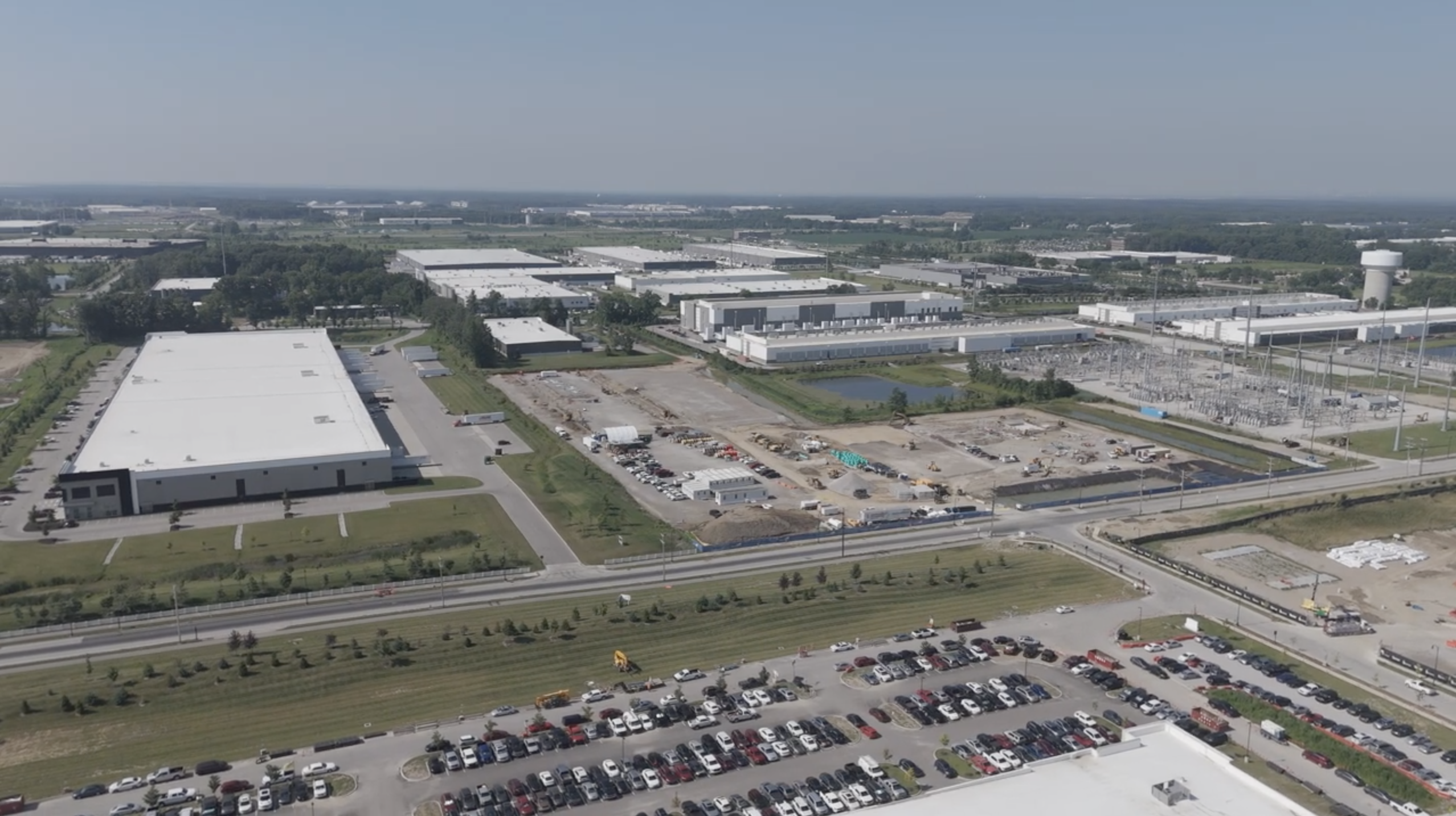
Central Ohio’s data center boom is fueling a new wave of energy construction. Two additional natural gas-fired power plants have been proposed for the New Albany area, while a record-setting battery storage system is underway in Licking County and a data center microgrid is planned.
Two More Gas-Fired Power Plants Proposed
Williams Cos., an energy infrastructure company based in Tulsa, Okla., is behind the two new proposals through its subsidiary, Will-Power OH, Columbus Business First reported. Will-Power OH is the same company building an on-site power project for Meta data centers in New Albany.
That first project consists of two 200-megawatt natural gas generators supplying Meta data centers on a 740-acre campus in the New Albany International Business Park called Socrates North and South. The Ohio Power Siting Board lists Sidecat LLC, a Meta affiliate, as the owner of the property.
Work on the first two plants started last year and will provide hundreds of jobs for affiliated members of the Columbus/Central Ohio Building and Construction Trades Council.
C/COBCTC Executive Secretary-Treasurer Dorsey Hager said it is too early to know whether the newly proposed projects will go to the building trades, though he expects them to generate more than 1,000 jobs.
Details on the 250-Megawatt and 500-Megawatt Plants
A June 18 Ohio Power Siting Board staff report states that the first proposed plant would have a 250-megawatt capacity and occupy 108 acres at the southwest corner of Clover Valley Road and Harrison Road NW in New Albany. Sidecat is the customer, and the staff report notes that the Meta affiliate plans to operate a data center on its campus adjacent to the proposed generating facility. Construction is expected to start this year, with completion targeted for the second quarter of 2027.
The second plant would be built nearby in Jersey Township, southeast of where Jug and Mink streets meet. When complete, the plant would produce 500 megawatts of power, according to the application. Williams Cos. expects to break ground in January 2027 and begin commercial operation by the end of 2028.
Behind-the-Meter Power for Data Centers
Every Will-Power OH project is “behind-the-meter,” meaning the power goes directly to a designated facility rather than flowing into the public electric grid.
“These projects are designed to deliver reliable, responsive power without impacting consumer prices,” Williams Cos. Senior Communications Specialist Kyle Tarpley told Columbus Business First by email. “Our ability to bring tailored energy solutions to data center projects is continually being recognized as a smart solution to balance grid reliability, affordability for consumers and the need for speed for these facilities.”
Why Data Centers Are Generating Their Own Electricity
The new power plants reflect a growing practice of data centers producing their own power, as the rapid expansion of these facilities has drawn criticism for straining the electric grid.
Columbus Business First reported that grid operator PJM Interconnection said late last year it had fallen short of its long-term reliability standard for the first time. PJM executive Stu Bresler told the publication there is “no doubt that data centers’ demand for electricity continues to far outstrip new supply.”
The hyperscale data centers being built across Central Ohio and the rest of the state need uninterrupted power to operate. To secure that supply, several data center owners, including Meta, Google and Amazon, have chosen to build their own power generation.
These proposals expand a growing lineup of energy construction connected to Central Ohio’s data center growth, which has kept area building trades members consistently working for nearly 10 years.
Flint Grid: A Record Battery Energy Storage System in Licking County
In addition to data centers and power plants, Central Ohio’s tradesmen and tradeswomen may soon have the chance to build the largest Battery Energy Storage System (BESS) east of the Mississippi River.
Eolian announced in a press release that construction is underway on the Flint Grid, a 200-megawatt, 5.3-hour duration grid-scale battery energy storage system in Jersey Township in Licking County. The system can store more than 1 gigawatt of electricity and react to shifting grid conditions within milliseconds, delivering power immediately where and when it is needed. As a highly flexible resource, it is designed to help keep the grid balanced all year.
Hager said it is also too early to know whether this project will be built union.
The Flint Grid Project is the first large-scale BESS to qualify for the PJM capacity market. It is also the largest battery storage system to clear the 2027/28 Residual Capacity Auction, accounting for more than half of all new battery storage capacity for that year.
In addition, it is the first grid-scale battery energy storage system to receive a permit from the Ohio Power Siting Board and the largest battery energy storage system built so far in Ohio and across the PJM footprint, setting a key precedent for future energy storage projects in the state.
“Flint Grid demonstrates how companies like Eolian have been investing in solutions to unlock the grid and reduce price pressures on consumers using proven and scalable technology,” Eolian Founder and CEO Aaron Zubaty said in a prepared statement. “This project requires hundreds of millions of dollars to construct, and we committed the necessary capital and resources years before today’s demand forecasts became headline news.”
Flint Grid is scheduled to be fully operational by late spring 2027.
Veolia to Run a 350-Megawatt Data Center Microgrid
Another on-site energy project may soon come to the New Albany area. Veolia, a Boston-based environmental services company with operations around the world, announced it will operate and maintain a 350-megawatt microgrid, independent of the main power grid, to serve a New Albany data center campus.
Veolia did not disclose the contract value or the client’s name. Company spokesman Adan Lisberg told The Columbus Dispatch only that “the client asked us not to name them.”
A Veolia news release states that the project will provide all the power for an AI data center campus in Ohio without depending on the traditional electric grid. The system would bring together natural gas engines, linear generators, battery energy storage and medium-voltage infrastructure into a single coordinated energy platform built to support continuous AI operations.
According to Veolia, combining on-site generation with large-scale battery storage lets the microgrid provide dependable, resilient power while relieving strain on already constrained public networks. The project is expected to include a 430-megawatt battery energy storage system and employ 35 to 40 full-time personnel on site.